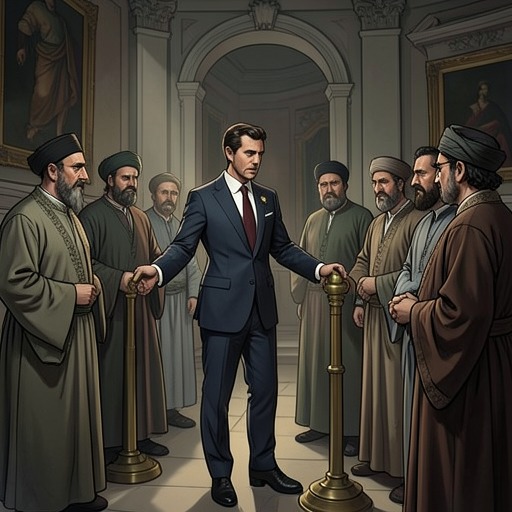
Doctor Narlikar
Midnight's ChildrenDoctor Narlikar is a Bombay gynecologist whose two ambitions—controlling childbirth and conquering the sea—draw him into the life of Ahmed Sinai and the changing city. A trusted friend who delivers Ahmed’s child, he later recruits him into a tetrapod venture built around land reclamation. His medical authority becomes the basis of a business scheme, while his death leaves behind a formidable group of women.
Identity and place in Bombay
Doctor Narlikar is an old friend of Ahmed Sinai and a resident of Escorial Villa, where he owns a flat above the Dubashes. Saleem describes him as dark-skinned like Amina, and says that he glows when excited or aroused. He dislikes children, even though his work brings them into the world; his professional identity is thus marked by a pointed contradiction between his medical specialty and his personal distaste.
Narlikar lives among the people William Methwold selected to occupy Methwold’s Estate. He is not merely a doctor in this social world: his connections, wealth-seeking, and presence in Bombay’s institutional corridors make him an active participant in the city’s commercial and physical transformation.
Physician and advocate of birth control
When Amina is in labor on the night India becomes independent, Narlikar attends her at Narlikar’s Nursing Home. The clinic is operating with a skeleton staff because many employees have gone to celebrate the nation’s imminent birth. Narlikar nevertheless takes charge of the delivery, reassuring Ahmed and promising to attend to Amina personally.
His bedside role sits alongside an outspoken public campaign for contraception. In his spare time, he lectures and writes pamphlets, insisting that birth control should be a national priority and predicting that success would put him out of work. The juxtaposition is characteristic: the doctor who dislikes babies is skilled at delivering them, while campaigning to prevent future births.
Narlikar’s friendship with Ahmed has a familiar ritual. On a January evening in 1948, he visits, and Ahmed proposes their customary chess game. They play shatranj, which gives Ahmed temporary relief from the complications of his life. This time Narlikar refuses the game and asks Ahmed to come with him, redirecting their friendship from private routine toward a commercial project.
The tetrapod scheme
Narlikar takes Ahmed along Warden Road and Hornby Vellard to look at the sea and the cement path to Haji Ali Dargah, which the tide will cover. He uses the visible boundary between water and land to explain Bombay’s earlier transformation: the British joined its islands, making land where the sea had been. The scene turns the city’s reclaimed geography into an argument for further development.
Narlikar produces a plaster-of-paris model, only two inches high, of a tetrapod. He proposes manufacturing the concrete structures by the thousands and bidding for reclamation contracts, presenting the scheme as a chance to become wealthy. His pitch joins technical object, geographic ambition, and promise of profit: the small model stands for a future in which engineered barriers and new construction extend the city into the sea.
Ahmed agrees to invest. Saleem interprets his father’s commitment as an effort to recover his position in the world, after feeling displaced by his son and deprived of his wife’s attention. Narlikar’s offer of partnership gives that private insecurity a public, financial outlet. Ahmed supplies capital; Narlikar promises contacts and access, arguing that his many connections as a gynecologist will open doors. They agree to divide the venture equally.
The scheme involves more than talk. Ahmed writes letters, knocks on doors, and pays black money; his name becomes known in the corridors of the State Secretariat as that of a Muslim spending rupees freely. The investment draws him toward political influence and danger, while he drinks himself to sleep without recognizing the risk. Narlikar’s entrepreneurial dream therefore changes the course of Ahmed’s life even as it grows out of a proposal framed as a straightforward partnership.
Relationships and narrative role
Narlikar’s relationship with Ahmed combines companionship and persuasion. Chess and gossip have made their visits habitual, but the tetrapod proposal changes the terms of their bond: the friend who interrupts a familiar game becomes the promoter who asks Ahmed to stake his money on a shared venture. The doctor’s confidence in his contacts helps make the scheme seem plausible to a man already anxious about missed opportunities.
His dealings with Amina and Ahmed also place him at the intersection of family history and public history. He attends the birth at the nursing home on the night of national independence, then later invites Ahmed to invest in a project that would reshape the city’s coastline. In both episodes he works at a threshold: one between pregnancy and birth, the other between sea and land. The echo links his medical and business roles without making them identical.
Saleem narrates Narlikar through hindsight, giving his actions consequences that Narlikar himself cannot foresee. The doctor’s later death will unleash a group of women described as able to overcome any obstacle. This retrospective framing enlarges the significance of his career: Narlikar is at once an individual physician, a promoter of urban development, and a hinge between the household’s private upheavals and Bombay’s remade landscape.
Death and aftermath
Narlikar’s death is recalled as the event after which a formidable group of women is released into the city. The account supplies no details of how he dies, but emphasizes the consequence: the women who had been associated with him can now act without an obstacle in their path. His absence thus becomes a force in the narrative, opening a new phase rather than simply closing his personal story.
Across his appearances, Narlikar’s projects bring together birth, population control, and reclamation. He delivers Amina’s child while campaigning against uncontrolled birth; he studies the sea’s advance and retreat before proposing that engineering convert water into usable land. Both kinds of work imagine the future as something that can be managed. Yet the novel’s retrospective account also stresses what exceeds management: Ahmed’s vulnerability to financial risk, the city’s changing geography, and the consequences set in motion after Narlikar is gone.